Designed a subscription model flow that increased customer retention for
Designed a gesture-based AR experience to explore lung pathology and increase
Impact
35%
increase in customer retention
Increased Prescription Intent in AR Experience
Designed a flexible subscription experience that introduced
wallet and external refund logic, addressed no-balance edge cases, and improved customer retention by 35%.
The AR experience strengthened physicians’ understanding of treatment pathways, increasing prescription intent during clinical sessions.
24%
reduced time-to-completion
Enhanced Gesture-Based Exploration
Reduced time-to-completion by 24% (~1m 04s) by optimizing
the subscription journey and removing friction across the
end-to-end experience.
AR gesture controls enabled intuitive exploration of lung pathology, allowing physicians to examine disease progression from multiple perspectives.
16%
increase in recurring revenue
Improved Clinical Understanding
By embedding transparency, flexibility, and operational clarity into the subscription journey, the redesigned experience drove a 16% increase in recurring revenue.
Interactive lung visualization helped physicians better understand cGVHD progression and underlying disease mechanisms.
Designed a gesture-based AR experience to explore lung pathology and increase
Impact
Increased Prescription Intent in AR Experience
The AR experience strengthened physicians’ understanding of treatment pathways, increasing prescription intent during
clinical sessions.
Enhanced Gesture-Based Exploration
AR gesture controls enabled intuitive exploration of lung pathology, allowing physicians to examine disease progression from multiple perspectives.
Improved Clinical Understanding
Interactive lung visualization helped physicians better understand cGVHD progression and underlying disease mechanisms.
Problem Overview
User Problem
To design an intuitive gesture interaction system that allows users to naturally control the AR experience without explicit instructions or traditional interface element.
Business Problem
The business required a more immersive and engaging format that could capture attention, encourage exploration, and improve the overall educational experience.
Client
Sanofi
Platform
Interactive AR Experience
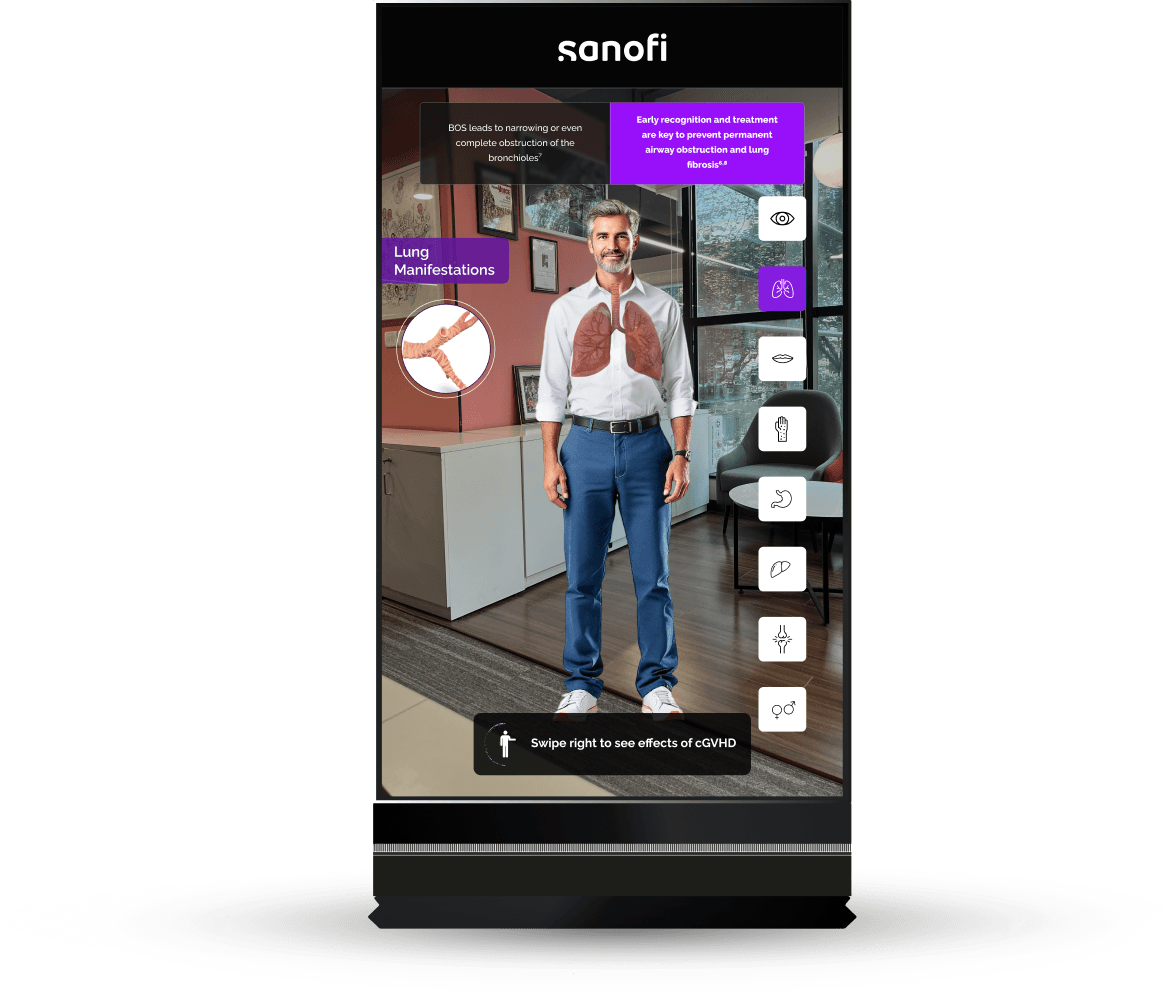
Problem Overview
User Problem
To design an intuitive gesture interaction system that allows users to naturally control the AR experience without explicit instructions or traditional interface element.
Business Problem
The business required a more immersive and engaging format that could capture attention, encourage exploration, and improve the overall educational experience.
Client
Sanofi
Platform
Interactive AR Experience
Designed a subscription model flow that increased customer retention for
Designed a gesture-based AR experience to explore lung pathology and increase
Impact
35%
increase in customer retention
Increased Prescription Intent in AR Experience
Designed a flexible subscription experience that introduced
wallet and external refund logic, addressed no-balance edge
cases, and improved customer retention by 35%.
The AR experience strengthened physicians’ understanding of treatment pathways, increasing prescription intent during clinical sessions.
24%
reduced time-to-completion
Enhanced Gesture-Based Exploration
Reduced time-to-completion by 24% (~1m 04s) by optimizing the subscription journey and removing friction across the end-to-end experience.
AR gesture controls enabled intuitive exploration of lung pathology, allowing physicians to examine disease progression from multiple perspectives.
16%
increase in recurring revenue
Improved Clinical Understanding
By embedding transparency, flexibility, and operational clarity into the subscription journey, the redesigned experience drove a
16% increase in recurring revenue.
Interactive lung visualization helped physicians better understand cGVHD progression and underlying disease mechanisms.
My Approach
01 - Heuristic Evaluation
01 - Clinical Expert Interviews
Conducted a heuristic review of the existing subscription and wallet flows to identify usability issues.
Experts highlighted the need for physicians to clearly understand immune-driven lung damage.
02 - User Interviews
02 - Interaction Risk Analysis
Interviewed 6 users to understand subscription decisions and wallet/refund expectations.
Identified risks that guided research and design decisions on gesture clarity and feedback.
03 - Behavioural Analytics
03 - Gesture Elicitation Study
Analysed drop-off points in the existing subscription funnel and to identify patterns in session data.
We conducted a gesture elicitation study to observe how users naturally express interaction intent in AR.
04 - Usability Testing
Participants interacted with the current subscription flow to identify friction points and confusion areas.
Tested high-fidelity UI flows while AR gesture interactions were validated through developer implementations.
05 - Prototype Testing
05 - Design Handoff
Validated the new subscription flow with wallet, refund transparency, and flexible plan controls.
Translated validated interactions into specifications and collaborated with engineering for AR implementation.
06 - Design Handoff
Translated validated flows into specs and aligned with engineering for subscription, wallet, and refund logic.
Translated validated dashboards into specifications and collaborated with engineering for data integration.
Problem Overview
User Problem
Users lacked clarity and control within the subscription experience. Ambiguity around refund handling combined with rigid plan structures made it difficult to select the right subscription type, resulting in friction and incomplete conversions.
To design an intuitive gesture interaction system that allows users to naturally control the AR experience without explicit instructions or traditional interface element.
Business Problem
The existing subscription model lacked flexibility and automation, constraining recurring revenue growth and long-term retention. The business required a scalable subscription framework supporting daily, weekly, and custom plans with automated wallet-based transactions.
The business required a more immersive and engaging
format that could capture attention, encourage exploration,
and improve the overall educational experience.
Client
Bisleri
Sanofi
Platform
Mobile & Desktop B2C Application
Interactive AR Experience
My Approach
My Approach
03 - Behavioural Analytics
03 - Gesture Elicitation Study
Analysed drop-off points in the existing subscription funnel and to identify patterns in session data.
Clustered raw interview insights to identify decision patterns and key signals used in regional prioritization.
04 - Usability Testing
Participants interacted with the current subscription flow to identify friction points and confusion areas.
Tested high-fidelity dashboard prototypes to evaluate how users interpret geo-analytical signals.
05 - Prototype Testing
Validated the new subscription flow with wallet, refund transparency, and flexible plan controls.
Validated map interactions, KPI prioritization, and multi-signal comparison for regional analysis.
06 - Design Handoff
Translated validated flows into specs and aligned with engineering for subscription, wallet, and refund logic.
Translated validated dashboards into specifications and collaborated with engineering for data integration.
01 - Clinical Expert Interviews
Experts highlighted the need for physicians to clearly understand immune-driven lung damage.
02 - Interaction Risk Analysis
Identified risks that guided research and design decisions on gesture
clarity and feedback.
03 - Gesture Elicitation Study
We conducted a gesture elicitation study to observe how users naturally express interaction intent in AR.
04 - Usability Testing
Tested high-fidelity UI flows while AR gesture interactions were validated through developer implementations.
05 - Design handoff
Translated validated interactions into specifications and collaborated with engineering for AR implementation.
06 - Design Handoff
Translated validated dashboards into specifications and collaborated with engineering for data integration.
Solution
01
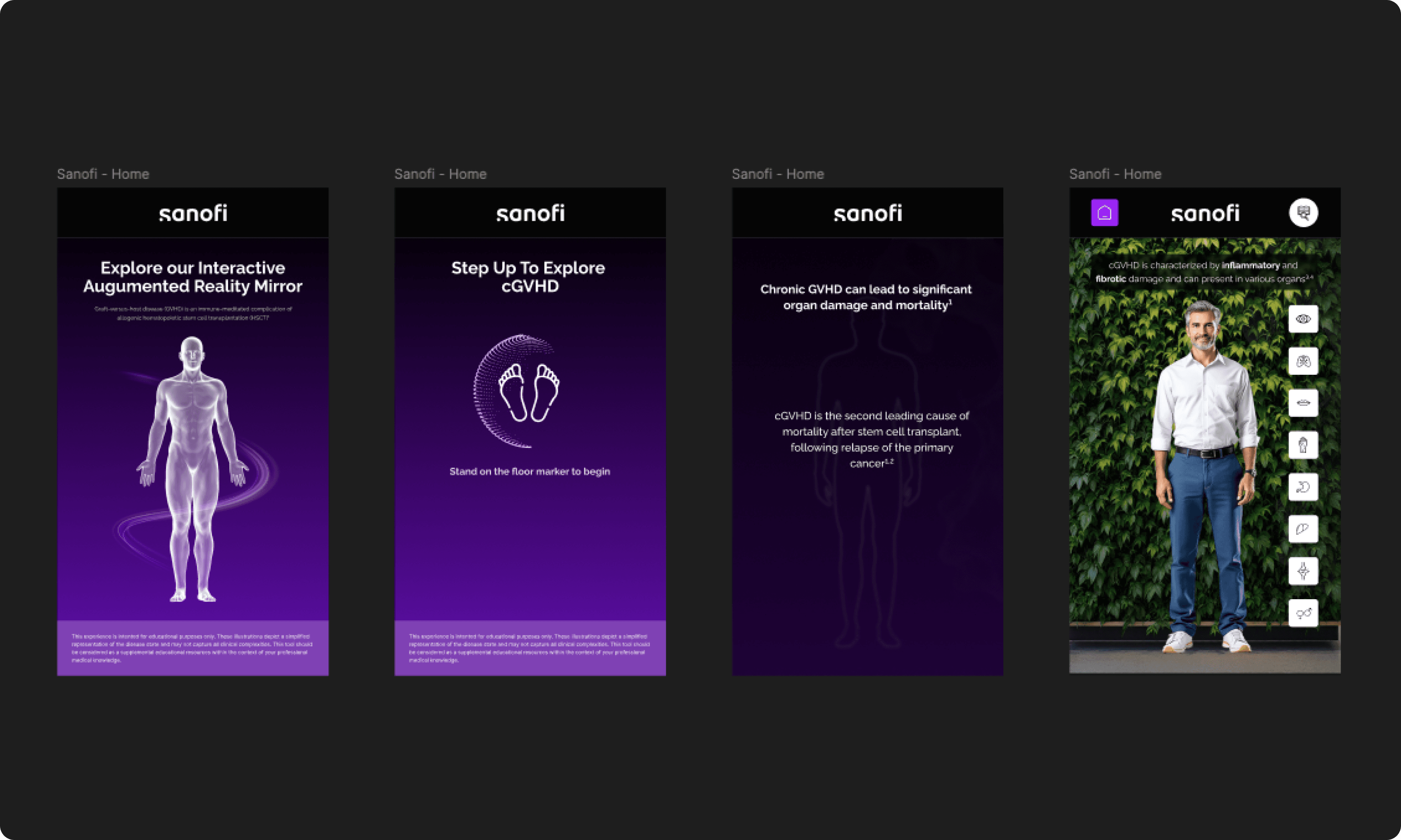
Sequential AR Exploration
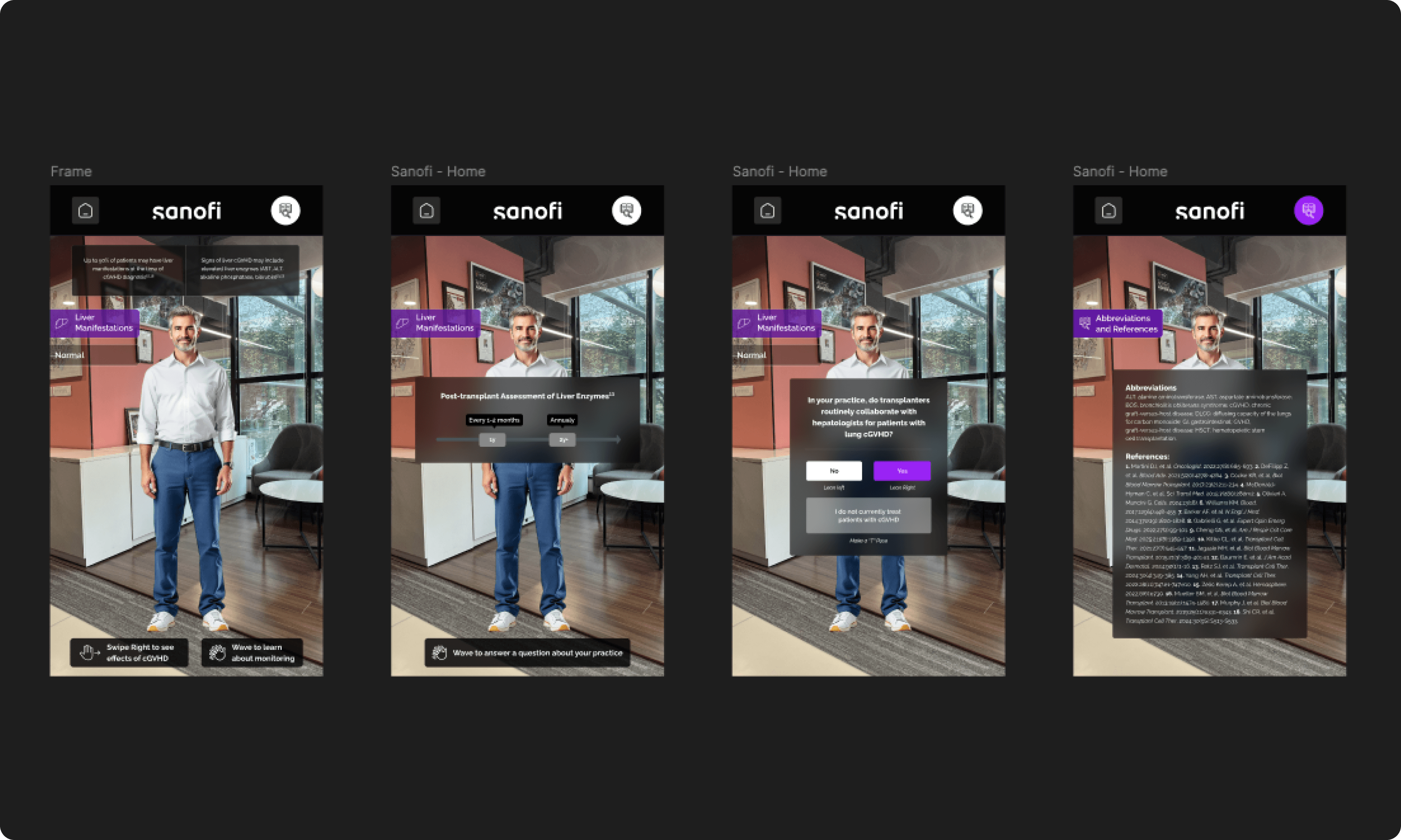
Without traditional UI controls, the AR experience used a structured exploration flow instead of unrestricted navigation.
Gesture cues and visual prompts guided users step-by-step through the AR journey, maintaining orientation while reducing navigation confusion and keeping attention on lung pathology exploration.
02
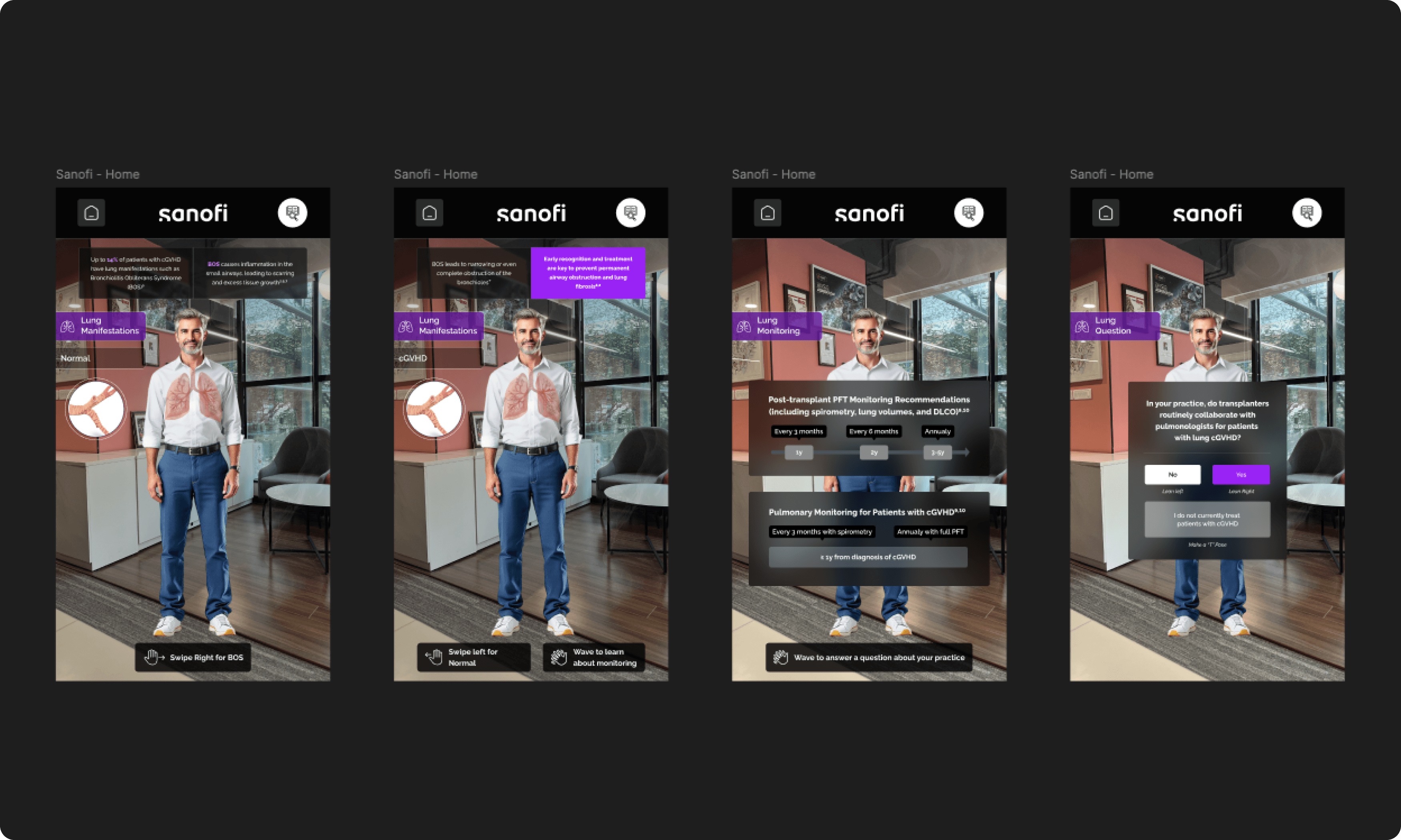
Real-Time Gesture Feedback
Subtle visual cues and highlights indicated when gestures were recognized, helping users understand system responses instantly.
After a selection, the experience automatically progressed to the next step, maintaining a smooth and continuous exploration flow.
03
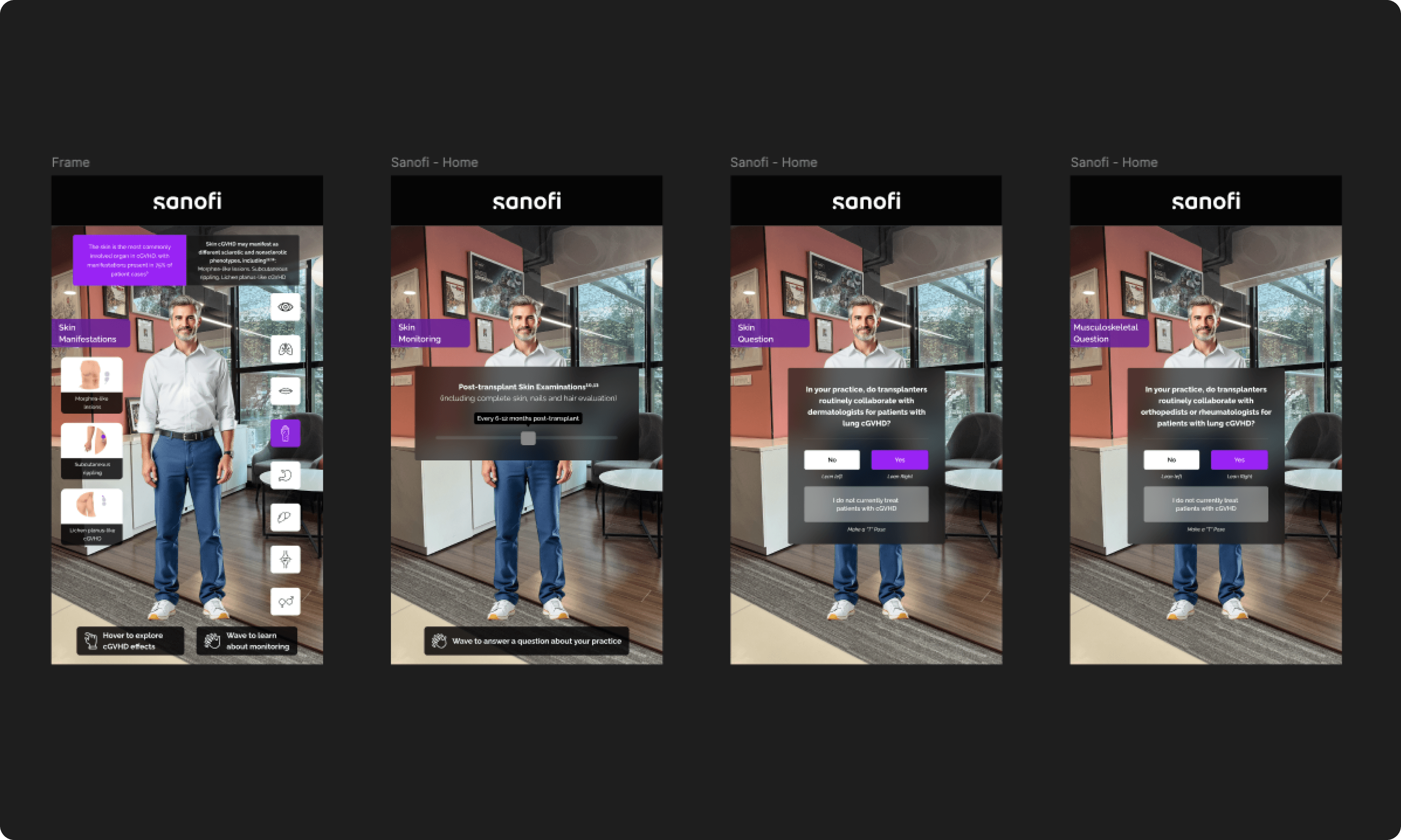
Simplified AR Interaction
The interaction model used a small set of consistent gestures to reduce cognitive load and make the experience easy to learn.
Natural movements such as hover, wave, and lateral motion allowed users to control the AR experience intuitively without requiring instructions.
04
Interaction Validation
& Refinement
An MVP version of the interaction model was tested through moderated usability sessions to evaluate gesture discoverability and interaction success.
Insights from testing informed refinements such as clearer prompts, improved visual feedback, and simplified navigation, ensuring the AR experience felt intuitive
and reliable.
Solution
01
Sequential AR Exploration
Without traditional UI controls, the AR experience used a structured exploration flow instead of unrestricted navigation.
Gesture cues and visual prompts guided users step-by-step through the AR journey, maintaining orientation while reducing navigation confusion and keeping attention
on lung pathology exploration.
02
Real-Time Gesture Feedback
Subtle visual cues and highlights indicated when gestures were recognized, helping users understand system responses instantly.
After a selection, the experience automatically progressed to the next step, maintaining a smooth and continuous exploration flow.
03
Simplified AR Interaction
The interaction model used a small set of consistent gestures to reduce cognitive load and make the experience easy to learn.
Natural movements such as hover, wave, and lateral motion allowed users to control the AR experience intuitively without requiring instructions.
04
Interaction Validation
& Refinement
An MVP version of the interaction model was tested through moderated usability sessions to evaluate gesture discoverability and interaction success.
Insights from testing informed refinements such as clearer prompts, improved visual feedback, and simplified navigation, ensuring the AR experience felt intuitive and reliable.
Solution
01
Modular Subscription
Framework
01
Sequential AR Exploration
Designed a scalable subscription model supporting:
Daily
Weekly
Custom frequency plans
Each plan was structured with guided defaults to reduce cognitive load while still allowing controlled personalization. The architecture ensured compatibility with backend routing logic and recurring payment mandates.
Without traditional UI controls, the
AR experience used a structured exploration flow instead of unrestricted navigation.
Gesture cues and visual prompts guided users step-by-step through the AR journey, maintaining orientation while reducing navigation confusion and keeping attention on lung pathology exploration.
02
Restructured
Child Order & Subscription Flow
02
Real-Time Gesture Feedback
The subscription system was built as a reusable framework that:
Reduced redundant steps & Simplifying plan selection across child orders & subscription orders
Minimized backtracking behavior observed in usability tests
Enabled flexible features like pause, skip, or predictive scheduling
Subtle visual cues and highlights indicated when gestures were recognized, helping users understand system responses instantly.
After a selection, the experience automatically progressed to the next step, maintaining a smooth and continuous exploration flow.
03
Subscription Cancellation Flow
along with Refund
03
Simplified AR Interaction
The cancellation flow determines refund eligibility based on the original payment source.
The flow identifies active vs inactive subscriptions and calculates refund eligibility before confirming cancellation.
If the subscription amount was debited from the in-app wallet, the remaining balance is automatically refunded back to the user’s wallet.
The interaction model used a small set of consistent gestures to reduce cognitive load and make the experience easy to learn.
Natural movements such as hover, wave, and lateral motion allowed users to control the AR experience intuitively without requiring instructions.
04
Wallet
Top-Up Experience
04
Interaction Validation
& Refinement
The wallet top-up experience was redesigned to support seamless subscription payments
Simplifying the wallet recharge flow, allowing users to quickly add funds when subscription payments fail or balances are low.
Enabling flexible wallet top-ups with preset amounts (₹500, ₹1000) and custom entries to ensure sufficient balance for upcoming deliveries.
An MVP version of the interaction model was tested through moderated usability sessions to evaluate gesture discoverability and interaction success.
Insights from testing informed refinements such as clearer prompts, improved visual feedback, and simplified navigation, ensuring the AR experience felt intuitive and reliable.
Trade-Offs
Trade-Offs
Trade-Offs
Interaction Freedom vs Guided Exploration
Interaction Freedom vs Guided Exploration
Interaction Freedom vs Guided Exploration
Context:
Allowing users to freely navigate the AR environment could encourage exploration, curiosity, and deeper interaction with the experience.
Context:
Allowing users to freely navigate the AR environment could encourage exploration, curiosity, and deeper interaction with the experience.
Decision:
We implemented a guided interaction flow that leads users through the experience step-by-step, ensuring clarity and smoother navigation.
Decision:
We implemented a guided interaction flow that leads users through the experience step-by-step.
Trade-off:
Free navigation increases flexibility but can easily disorient users in gesture-based systems where no visible controls exist.
Trade-off:
Free navigation increases flexibility but can easily disorient users in gesture-based systems where no visible controls exist.
Mitigation:
Visual cues and contextual prompts ensured users understood each step while maintaining a sense
of exploration.
Mitigation:
Visual cues and contextual prompts ensured users understood each step while maintaining a sense
of exploration.
Immersion vs Interaction Guidance
Immersion vs Interaction Guidance
Immersion vs Interaction Guidance
Context:
The experience aimed to minimize visible UI to maintain immersion.
Context:
The experience aimed to minimize visible UI to maintain immersion.
Decision:
Subtle prompts and contextual hints were introduced to guide initial interactions.
Decision:
Designed structured flexibility with guided defaults and clear plan comparisons to balance choice and clarity.
Trade-off:
Reducing interface elements improved immersion but made interaction cues less obvious.
Trade-off:
Reducing interface elements improved immersion but made interaction cues less obvious.
Mitigation:
Instructional cues appeared only when needed to maintain immersion and support discoverability.
Mitigation:
Instructional cues appeared only when needed to maintain immersion and support discoverability.
Gesture Complexity vs Learnability
Gesture Complexity vs Learnability
Gesture Complexity vs Learnability
Context:
The system could support multiple gestures
for navigation and interaction.
Context:
The system could support multiple gestures
for navigation and interaction.
Context:
The system could support multiple gestures for
navigation and interaction.
Decision:
We limited the system to a small, consistent
gesture vocabulary.
Decision:
We limited the system to a small, consistent
gesture vocabulary.
Decision:
We limited the system to
a small, consistent
gesture vocabulary.
Trade-off:
A large gesture set increases flexibility but also increases cognitive load and errors.
Trade-off:
A large gesture set increases flexibility but also increases cognitive load and errors.
Mitigation:
A predictable gesture pattern helped users quickly learn and remember interactions.
Mitigation:
Chosen trust and expectation alignment over short-term conversion gains.
The redesigned subscription framework transformed a rigid, friction-heavy flow into a scalable and operationally aligned model that balanced flexibility, transparency, and backend feasibility. The solution reduced ambiguity, stabilized recurring revenue mechanics, and established a foundation for long-term subscription growth.
The final interaction model reduced friction in gesture-based navigation and enabled users to engage with the AR experience more confidently and efficiently with the expected increase of Prescription Intent Rate.
Outcome
Outcome
The final interaction model reduced friction in gesture-based navigation and enabled users to engage with the AR experience more confidently and efficiently with the expected increase of Prescription Intent Rate.